
Academy
Coaches 2027
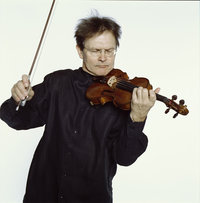
Ernst Kovacic
Conductor + Violin, Coach
With Ernst Kovacic and Sophie Schafleitner (formerly Léo Marillier) coaching the violin class at the impuls Academy 2027 a wide range of expertise comes together. Sophie Schafleitner, longtime member of Klangforum Wien, has also been active as soloist and chamber music. Collaboration and exchange with the most significant composers of our times has led to works for solo violin dedicated to her (such as by Liza Lim, Ying Wang, Hannes Kerschbaumer, and Aureliano Cattaneo) and further works for her duo with Krassimir Sterev by Sara Glojnarić and Franck Bedrossian amongst others. Formerly assistant of Prof. Gerhard Schulz’s violin class in Vienna, she is currently responsible for violin and chamber music at the Performance Practice in Contemporary Music-program at KUG in Graz.
With these two coaches, participants of the violin class are given the opportunity to receive support on many levels – from, amongst others, advanced instrumental techniques, questions of interpretation and musicological topics, up to insights into what it means to be a musician. In any case participants are encouraged to suggest pieces they would like to work on during the Academy, and raise specific questions and individual needs. Aside from 1:1 lessons and coaching of solo literature, participants will also be connected with other instrumentalists for chamber music playing, and, triggered by a couple of Special Programs, also with young composers at the Academy.
I grew up in a musical environment with plenty of casual situations for learning how to "lead" ensembles: church music, various opportunities offered by our thriving music school, many little public and private occasions that demanded quick planning, programming, and rehearsing. When I started studying in Vienna, I couldn’t quite decide between the violin and the organ, but I soon chose the violin and was a "violinist" for many years. Anyone who has played the pedals of an organ for very long won’t forget this, even when playing the violin – with Bach, especially, the experience of countrapuntal thinking, leaves a lasting impression. And even as a soloist performing with an orchestra, if one has conducted choirs and ensembles in one’s youth, one won’t stop thinking about all the other parts surrounding the soloist. And so, departing from Mozart’s violin concertos, it seemed only natural – in those works of the concerto repertoire that can be performed without a conductor – to lead the ensemble from the solo violin position.
The next developmental step arose from the practical experience of concert playing: orchestras and organizers came to respect my knowledge about scores, and I was gradually entrusted with entire programs – at first as a directing soloist, then also as a conductor. And there was another source that nurtured my interest in scores: The "Kulturtage", a cultural festival held in my hometown of Kapfenberg, sparked my curiosity about New Music very early on, and I began studying scores for new works, amazed at the range of sound possibilities and formal factors. This, of course, requires a careful eye and the ability to imagine how tones might sound – often one can no longer rely on what one has heard in the past. And finally, the conductors with whom I worked as a violinist were secretly teachers to me too: I sought not only to integrate into my own conducting practice the positive aspects of their conducting and rehearsal methods but also to avoid their obvious mistakes.
As a conductor, being also still an active soloist and chamber musician, I feel a strong desire to encourage orchestra musicians, especially in large orchestras, to play with the kind of vitality that is second nature to chamber musicians and soloists. Acquiring the motivational skills necessary for this is not only a constant challenge but also a perpetual pleasure.
I would like to mention a key moment I experienced as a young violinist. I was substituting at the Vienna State Opera and we were rehearsing The Ring with Karajan. He spent a good 45 minutes working with the first violins on the great solo line in act 3 of Siegfried. To me this was an enlighteningly profound experience. Each note, each nuance, each line took on meaning and expression. This extraordinary moment of the musical and conducting potential to shape a work still inspires and guides me to this day!
Ernst Kovacic will be present at impuls between February 8th and 15th.
Special Programs with
Ernst Kovacic
Ernst Kovacic . Composing for violin solo and chamber music formations